Is My Coffee Dehydrating Me? (The Hydration Myth)
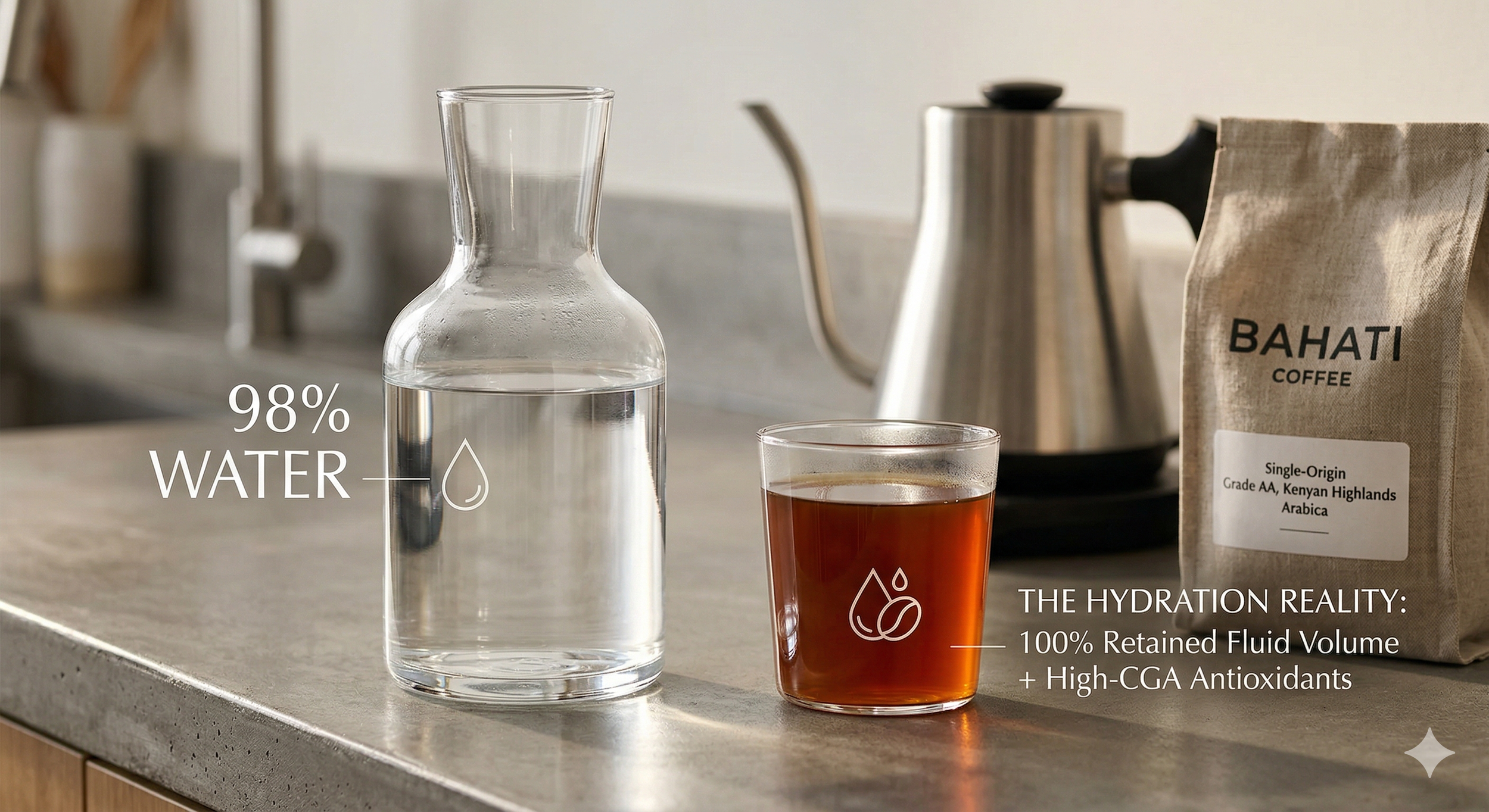
A high-end, minimalist visual visualizing the coffee hydration myth. On the left, a glass carafe of fresh water labeled "98% WATER," and on the right, a glass tumbler of brewed Bahati Coffee (Kenyan Highlands Grade AA Arabica) labeled "THE HYDRATION REALITY: 100% Retained Fluid Volume + High-CGA Antioxidants," demonstrating that quality coffee does not cause dehydration.
We have all heard the golden rule of caffeine: For every cup of coffee you drink, you need to drink a glass of water to offset the dehydration. It is one of the most widely accepted "facts" in the health and wellness world. People actively limit their coffee intake because they are terrified of drying out their bodies, aging their skin, and ruining their hydration levels.
There is just one problem: The science says it’s completely false.
If you are drinking high-quality coffee, you aren't dehydrating yourself. You are actually contributing to your daily fluid intake. It is time to debunk the 50-year-old hydration myth.
Where the Myth Started (And Why It’s Wrong)
The myth stems from a fundamental misunderstanding of how caffeine works in the body.
Caffeine is a mild diuretic, meaning it can signal your kidneys to release extra sodium and water through urine. Decades ago, researchers looked at this single mechanism and concluded that coffee must be dehydrating.
But they forgot to account for the most obvious ingredient in your mug: the water.
Modern fluid-balance studies have proven that the volume of water in a standard cup of coffee completely counteracts the mild diuretic effect of the caffeine. When you drink a cup of coffee, your body retains the vast majority of that liquid. A study published in the Public Library of Science (PLOS One) explicitly found no significant difference in hydration levels between people who drank moderate amounts of coffee and those who drank plain water.
Your morning ritual isn't drying you out. It’s hydrating you.
Why Does My Mouth Feel Dry, Then?
If coffee isn't dehydrating, why do so many people get that "dry mouth" feeling after finishing a cup?
The answer comes back to the quality of the beans. If you are drinking cheap, mass-produced commodity coffee, you are likely drinking low-grade Robusta beans or over-roasted filler. These cheap beans contain abnormally high levels of harsh tannins and bitter acids.
When these harsh compounds hit your tongue, they bind to the proteins in your saliva, causing your saliva to temporarily lose its lubricating power. This creates a sensation called astringency—a rough, dry, sandpaper feeling in your mouth. You aren't actually dehydrated; your mouth has just been stripped of its natural moisture by low-quality, highly acidic beans.
Drink Better, Hydrate Better
You shouldn't have to choose between your focus and your hydration, and you certainly shouldn't have to put up with the astringent "dry mouth" of cheap coffee.
At Bahati Coffee, we eliminate the harshness entirely. We source our Single-Origin, Grade AA Arabica directly from the Kenyan Highlands. Because our beans are grown at extreme, cold altitudes, they naturally develop a vibrant, smooth, and complex flavor profile without the bitter, astringent tannins found in low-altitude commodity crops.
We meticulously medium-roast our beans to highlight their natural, bright fruit notes, resulting in a cup that is incredibly smooth, completely clean, and biologically hydrating.
Stop limiting your productivity because of a 50-year-old myth. Pour the second cup.
Shop Bahati Coffee’s Grade AA Kenyan Beans Here and experience the clean, hydrating energy of top-tier Arabica.