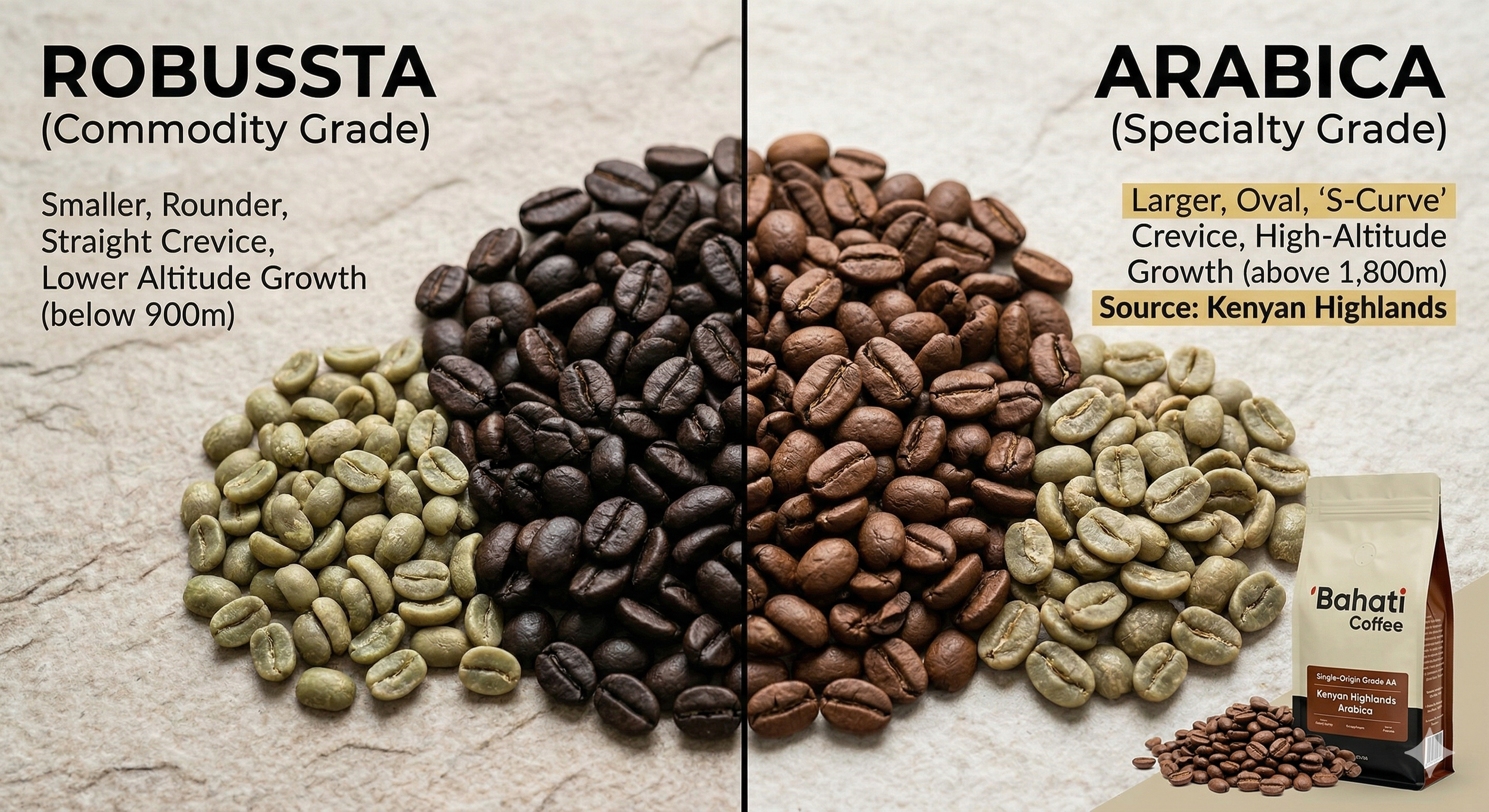
A side-by-side infographic comparing Robusta and Arabica coffee beans. The left side displays smaller, rounder Robusta beans, labeled as commodity grade and grown at lower altitudes. The right side displays larger, oval Arabica beans, labeled as specialty grade and sourced from the high-altitude Kenyan Highlands, featuring a bag of Bahati Coffee to represent premium quality.
Walk down the coffee aisle of any major grocery store, and you’ll see an overwhelming wall of options. Brightly colored bags, rustic burlap designs, and bold fonts scream for your attention. It feels like there are thousands of choices.
But here is the coffee industry’s dirtiest secret: the illusion of choice.
While there are over 20,000 coffee brands in the world, the vast majority of them are selling you the exact same product. If you’ve ever wondered why so many "different" coffees leave you with the same bitter, ashy aftertaste, you need to understand how the different coffee types are actually sourced and sold.
The Two Main Coffee Types: Arabica vs. Robusta
To understand why most brands taste identical, you have to look at the biology of the beans. In the commercial market, there are really only two primary coffee types that matter: Robusta and Arabica.
1. Robusta (The Cheap Filler): Robusta beans are incredibly cheap to grow. They thrive at low altitudes and are naturally resistant to pests. The tradeoff? They taste like burnt rubber and battery acid. Many massive, commercial brands use Robusta beans as a cheap filler to increase their profit margins, heavily roasting them to hide their harsh, astringent flavors.
2. Arabica (The Flavor Standard): Arabica beans are much harder to grow. They require higher altitudes, specific climates, and more care. But the reward is a bean that is naturally sweeter, smoother, and infinitely more complex.
Here is the catch: Just because a bag says "100% Arabica" doesn't mean it's high quality. The market is flooded with low-grade, commodity Arabica that is bought in massive bulk, mixed together from dozens of different countries, and white-labeled by hundreds of different brands. You might be buying a new bag, but you are drinking the same stale, commodity-grade coffee types as everyone else.
The Specialty Tier: Why Origin Matters
If you want to break out of the commodity trap, you have to look beyond the basic coffee types and look at grade and origin.
The reason mass-produced coffee tastes flat is because it's a blend of average beans from all over the world, roasted dark enough to make them all taste uniform. True specialty coffee does the exact opposite. It isolates the best beans from the best regions and roasts them to highlight their unique geographic thumbprint.
The Kenyan Highlands Standard
At Bahati Coffee, we don't play the blending game, and we certainly don't white-label commodity beans. We sell one specific, exceptional type of coffee: Single-origin, Grade AA Arabica.
Grade AA is the highest quality classification of Kenyan coffee, prized for its large bean size, intense flavor, and striking clarity. Grown in the extreme altitudes and rich volcanic soil of the Kenyan Highlands, our beans develop a bright, tart fruitiness and a robust depth that you simply cannot find in a supermarket blend.
We partner directly with the farmers of the Bahati Specialty Coffee Co-Op to ensure that the beans in your bag are uncompromised, ethically sourced, and roasted to absolute perfection.
Stop settling for the illusion of choice. Experience what top-tier coffee is actually supposed to taste like.
Shop Bahati Coffee’s Grade AA Kenyan Beans Here and upgrade your cup.